Card 01 / extended
Crossings
Eight ports carry most of the commercial traffic between the two countries. Each one has a shape: a bridge with a long approach, a tunnel that empties into a city street, or a single prairie lane with a weigh station on the far side. The wait on a card is a reading from that shape, not a national average.
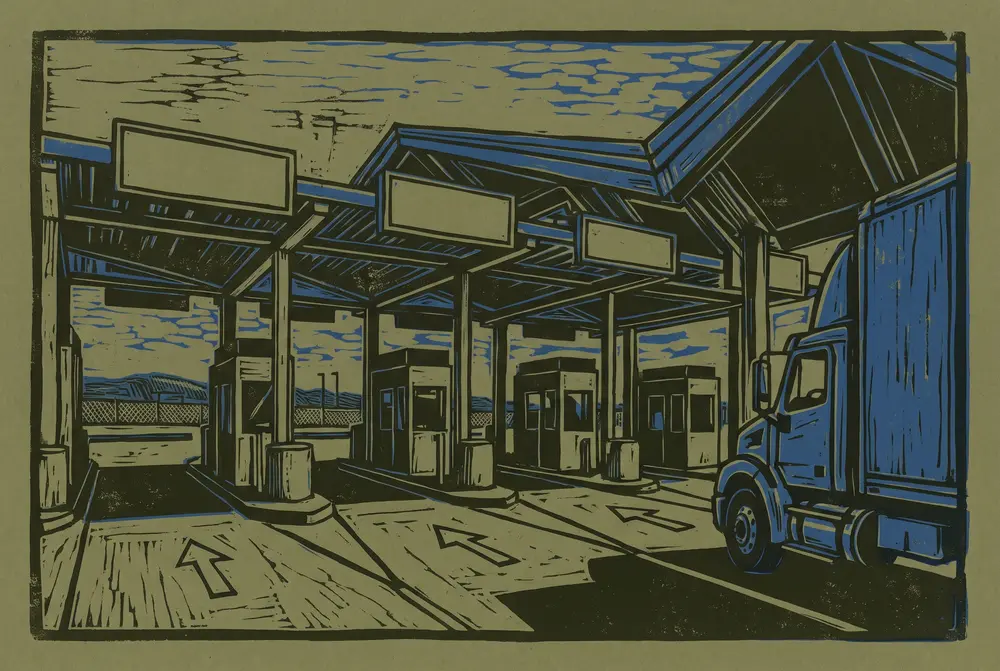
The ports on file
| Port | Crossing | Commercial lanes | Peak window | Typical wait |
|---|---|---|---|---|
| Ambassador Bridge | Windsor, ON / Detroit, MI | 4 lanes | 06:00 to 09:00 | 35 min |
| Blue Water Bridge | Sarnia, ON / Port Huron, MI | 3 lanes | 05:30 to 08:30 | 20 min |
| Peace Bridge | Fort Erie, ON / Buffalo, NY | 4 lanes | 07:00 to 10:00 | 55 min |
| Rainbow Bridge | Niagara Falls, ON / Niagara Falls, NY | 2 lanes | 09:00 to 12:00 | 25 min |
| Lewiston-Queenston | Queenston, ON / Lewiston, NY | 3 lanes | 06:30 to 09:00 | 15 min |
| Thousand Islands | Lansdowne, ON / Alexandria Bay, NY | 2 lanes | 08:00 to 11:00 | 10 min |
| Lacolle | Lacolle, QC / Champlain, NY | 3 lanes | 06:00 to 09:30 | 30 min |
| Emerson | Emerson, MB / Pembina, ND | 1 lane | 07:00 to 10:00 | 45 min |
Peak windows are desk observations from the last four weeks. Wait figures are the median of the morning peak, not the worst hour.
How a queue forms
A queue at a bridge is set by the approach, not by the booth. The Ambassador Bridge funnels four lanes of Huron Church Road into a plaza that can hold roughly 900 trucks. Once that plaza fills, the line backs onto city streets and the wait grows faster than the arrival rate, because every truck that blocks an intersection slows the next hundred behind it.
Prairie ports behave differently. Emerson has a single commercial lane and a wide approach, so a 45 minute wait there is usually a staffing gap or an inspection hold rather than a physical backup. A dispatcher who reads only the number will misjudge both ports in the same way.
Peak windows
Northbound and southbound peaks do not line up. Southbound freight into the United States builds from 05:30 and clears by 09:30 on most weekdays. Northbound loads into Canada arrive later, between 14:00 and 18:00, which is why a driver who crosses at noon in one direction and returns at four in the other meets two different queues.
Friday changes the pattern on produce lanes. Reefer traffic out of Leamington and the Holland Marsh competes for the same trailers that carry auto parts during the week, and the Peace Bridge absorbs most of the overflow when the Ambassador plaza fills.
What the numbers leave out
A wait time does not say whether the line is moving. Ten minutes with the engine off in a closed lane is not the same as ten minutes rolling toward the booth, and the difference matters when a driver's hours are nearly spent.
The card also leaves out the return trip. A carrier that clears southbound in 25 minutes can lose the gain on the northbound side the same afternoon, especially at Lacolle, where broker hours end at 20:00 and a late arrival turns into an overnight.
Weather is recorded only when it closes a lane. Snow on the approach is a fact of the route for four months of the year, and the desk notes closures rather than conditions.
Lane reports from drivers and brokers are checked against the port office before a card is amended. Send one through the contact desk.